
Harvia vs SaunaCloud: Traditional Electric Heaters
You are weighing a Harvia electric heater against SaunaCloud's infrared cabins, and the two solve different problems. Harvia sells the traditional Finnish sweat, while SaunaCloud builds infrared rooms with red light panels. That distinction drives everything from heat feel to installation.
This comparison covers heater technology, heat type and wellness experience, materials and warranty, and pricing. By the end you will know which option fits your space and goals, plus a clear verdict rather than a shrug.
Quick Verdict: Harvia vs SaunaCloud on Traditional Electric Heaters
If you want a traditional electric sauna with a wall-mounted heater and a rock basket, Harvia is the established choice, while SaunaCloud offers a custom infrared sauna with integrated red light therapy but no traditional electric heater.
The two brands serve different goals. Harvia builds traditional electric heaters such as the KIP and Cilindro, using resistive heating elements, sauna stones, and thermostat control to create a classic Finnish sauna. SaunaCloud does not manufacture traditional electric heaters at all.
Instead, SaunaCloud makes custom infrared saunas built around its VantaWave® heaters, with red light therapy integrated into the benches and backrests. That makes this less a head-to-head sauna heater comparison and more a choice between two sauna heating technologies.
| Factor | Harvia | SaunaCloud |
|---|---|---|
| Core product | Traditional electric sauna heaters with stones and a rock basket | Custom infrared saunas with VantaWave® heaters |
| Heating method | Resistive heating elements warming sauna stones | Infrared radiant heat |
| Controls | Typically thermostat control and timers, with some models offering digital or smart options | Not a traditional electric heater, so heater wattage and rock basket specs do not apply |
| Added therapies | Steam from water poured on hot stones | Red light therapy at clinical proximity (2 to 6 inches) |
| EMF profile | Varies by model and installation | VantaWave® heaters emit under 3mG EMF, often below 0.5mG |
For buyers who want the löyly experience, splashing water on heated rocks in a hot room, Harvia's lineup fits that expectation directly. Its heater wattage and kilowatt ratings are sized to sauna cubic volume, and safety features like overheat protection and a safety cutoff are standard considerations in this category.
SaunaCloud's differentiators sit elsewhere. VantaWave® heaters reach a 190°F surface temperature at 7.9 microns peak wavelength, and the integrated red light therapy is positioned at clinical proximity rather than across the room. Those are meaningful points for anyone prioritizing infrared heat and light therapy over steam.
The honest summary: SaunaCloud is not a direct competitor in the traditional electric heater category. If a rock basket and steam are non-negotiable, Harvia is the natural fit. If you want a custom infrared sauna with low-EMF heaters and built-in red light therapy, SaunaCloud is the stronger match for that goal.
At a glance: how SaunaCloud compares to Harvia on the features that matter most.
| Feature | SaunaCloud | Harvia |
|---|---|---|
| Traditional Electric Heaters | ✗ | ✓ |
What Is SaunaCloud?
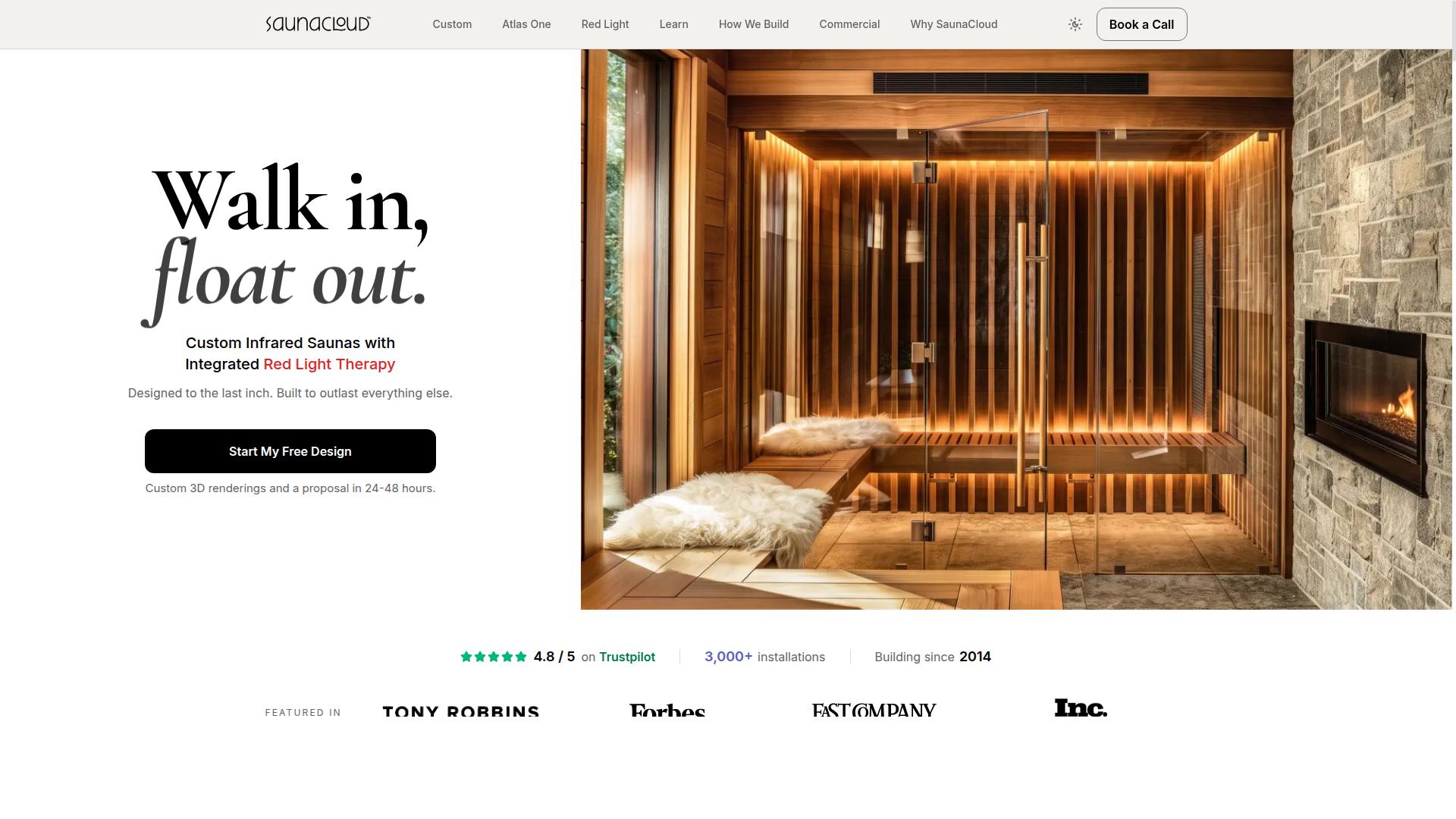
SaunaCloud is a California-based manufacturer founded in 2014 that handcrafts custom infrared saunas with integrated red light therapy, not traditional electric heaters. The company operates from facilities in Diamond Springs, California and Montreal, Quebec, and has completed more than 3,000 installations across North America.
Every sauna is designed, engineered, and built in-house. That includes the VantaWave® heaters, CORE 5™ power supplies, printed circuit boards, Wi-Fi control systems, and red light therapy arrays. This level of vertical integration is unusual among infrared sauna brands, most of which assemble imported components.
SaunaCloud's product line centers on custom infrared models, including the Atlas and Sierra. These cabins pair VantaWave® ultra-low-EMF carbon heaters with integrated 660nm red and 850nm near-infrared LED therapy positioned at clinical proximity, roughly 2 to 6 inches from the skin.
The company backs its saunas with a 7-year limited lifetime warranty, a signal of how it views the expected service life of its builds. Buyers choose SaunaCloud for a tailored infrared cabin with light therapy built in, not for off-the-shelf hardware.
That distinction matters for this sauna heater comparison. SaunaCloud does not produce traditional electric sauna heaters, rock baskets, or resistive heating elements. If you are shopping for a Finnish sauna equipment setup built around an electric sauna stove, a SaunaCloud cabin is not a direct alternative to a Harvia-style heater.
The two brands solve different problems. Harvia supplies the heating core of a traditional hot-room sauna. SaunaCloud supplies a complete infrared cabin with therapy lighting. Understanding that split prevents a mismatched purchase before you compare wattage, stones, or controls.
What Is Harvia?
Harvia is a Finnish sauna manufacturer known for traditional electric sauna heaters such as the KIP and Cilindro, which use resistive heating elements and sauna stones to create a classic Finnish sauna experience. The company has built its reputation on decades of experience in the Finnish sauna market, and its product line reflects that heritage.
Harvia's catalog centers on traditional electric heaters rather than infrared panels. The range generally includes wall-mounted heater designs and floor-standing heater options, so buyers can match a unit to the footprint of a given room.
Most Harvia models follow the same basic sauna heating technology. Resistive heating elements warm a rock basket filled with sauna stones, and the stones then radiate heat and steam when water is ladled over them. This is the familiar electric sauna stove approach that defines the Finnish sauna tradition.
Control options vary by model. Simpler units typically use manual controls, while other models commonly include a digital controller and, in some cases, Wi-Fi connectivity for app control and remote operation. These smart sauna features are generally offered as upgrades rather than standard on every heater.
Harvia heaters are typically available in several wattage ratings to suit different room sizes. Matching heater wattage to sauna cubic volume is an important part of any sauna heater comparison, and manufacturers usually publish guidance on this. Commonly included safety and convenience features include overheat protection, a safety cutoff, and a built-in timer.
It helps to think of Harvia as a benchmark for the traditional category. When buyers research a Harvia KIP or Harvia Cilindro, they are usually comparing rock-based electric heat against other approaches, including the infrared focus that defines SaunaCloud. Understanding that distinction is the key to reading the rest of this comparison.
A few general traits are worth noting before comparing brands:
- Heat type: rock-based electric heat with stones and resistive elements
- Installation: wall-mounted and floor-standing configurations
- Controls: manual, digital, and sometimes Wi-Fi enabled
- Safety: commonly overheat protection and timers
These are broad category characteristics rather than a specification sheet. Exact features, wattage ranges, and control packages differ from one model to the next, so buyers should confirm details for the specific unit they are considering.
Features Compared
This section compares the core features of Harvia traditional electric heaters and SaunaCloud infrared saunas, focusing on heater technology, heat type, materials, and warranty.
The comparison covers three areas: heater technology, heat type and wellness experience, and materials, build quality, and warranty. Each area matters differently depending on how you plan to use the sauna.
One important caveat up front: Harvia and SaunaCloud use fundamentally different heating methods. Harvia builds traditional electric sauna stoves that heat a room with stones and steam, while SaunaCloud builds infrared cabins with radiant heaters and integrated red light therapy.
That means this is not an apples-to-apples comparison. It is closer to comparing two distinct sauna traditions, and the right choice depends on which experience you are actually after.
Heater Technology: Traditional Electric Elements vs VantaWave® Infrared
Harvia heaters rely on resistive heating elements that warm sauna stones in a rock basket to produce steam when water is poured, while SaunaCloud uses VantaWave® carbon infrared heaters that emit radiant heat without stones or steam.
In a Harvia electric sauna stove, resistive elements heat the rock basket directly. When water hits the hot stones, it flashes into steam and raises humidity in the cabin. Models like the Harvia KIP and Harvia Cilindro follow this same basic principle.
Harvia heater wattage, or kilowatt rating, must be matched to the sauna's cubic volume. Undersized heaters struggle to reach temperature, while oversized ones can cycle too aggressively. Most Harvia units pair with thermostat control, a built-in timer, and overheat protection with a safety cutoff.
Some models offer a digital controller or manual controls, and certain configurations support Wi-Fi connectivity for remote operation. Wall-mounted and floor-standing options exist depending on the model and room layout.
SaunaCloud takes a different path. Its VantaWave® carbon infrared heaters emit under 3 mG of EMF, often below 0.5 mG, and reach a 190°F surface temperature at a 7.9 microns peak wavelength. There are no stones, no rock basket, and no water.
The practical contrast is straightforward: Harvia delivers steam and high air temperature, while SaunaCloud delivers radiant infrared heat that warms the body more directly. Neither is a flaw. They are simply different sauna heating technologies aimed at different rituals.
Heat Type and Wellness Experience: Air Temperature vs Clinical-Proximity Red Light
Harvia electric heaters heat the air in the sauna to high temperatures (often 160-190°F) for a traditional Finnish sweat, whereas SaunaCloud infrared saunas warm the body directly with radiant heat and add red light therapy at clinical proximity for potential recovery and skin benefits.
The Harvia experience is the classic Finnish sauna ritual. The cabin air gets hot, the stones produce steam when you ladle water, and sessions tend to be shorter and more intense. Many users alternate between the hot room and a cool break.
SaunaCloud works differently. Infrared heat warms the body directly, so the air temperature stays lower even though you still sweat. Users often report that this feels gentler and easier to sit through for longer sessions.
What sets SaunaCloud apart is its integrated 660nm red + 850nm near-infrared LED therapy, built into the benches and backrests at clinical proximity of 2 to 6 inches from the skin. That close positioning is the point, since distance matters for light-based therapy.
Red light therapy is not a feature of Harvia electric heaters, which focus entirely on heat and steam. Research suggests red and near-infrared light may support recovery and skin health, and users often report those benefits, though results vary from person to person.
So the wellness experience diverges in two ways: heat delivery and light therapy. If your goal is a traditional steam sweat, Harvia fits. If you want direct body warming plus an added wellness dimension, SaunaCloud covers more ground.
Materials, Build Quality, and Warranty
Harvia electric heaters are typically built with stainless steel or painted metal casings and come with standard manufacturer warranties, while SaunaCloud saunas are custom-built with wood interiors and backed by a 7-year limited lifetime warranty.
Harvia's metal casings and stone baskets are durable and designed for the heat and moisture of regular sauna use. Warranty terms for traditional electric sauna stoves are commonly in the range of 1 to 5 years depending on model and region, so check the specifics for any unit you consider.
SaunaCloud takes a different approach to materials. Its cabins use clear-grade kiln-dried Western Red Cedar with no particle board, glues, or veneers, and the heaters and LED panels are integrated into the wood construction. Outdoor models are weather-sealed with cedar and stainless steel.
Build confidence shows in the track record. SaunaCloud has been building since 2014 with 3,000+ installations, and every unit ships as a complete kit with heaters, control system, power supply, cedar, fasteners, and installation support.
On warranty, SaunaCloud offers a 7-year limited lifetime warranty, a notably longer commitment than the typical industry range. The company also holds a BBB A+ rating since 2015 and a 4.8/5 Trustpilot rating from 217 verified reviews.
For buyers weighing long-term value, the materials and warranty picture favors SaunaCloud. Harvia remains a respected traditional sauna manufacturer, but its warranty terms and metal-and-stone construction sit in a more conventional range.
Pricing Compared
Harvia electric heaters are generally sold as standalone units with prices varying by wattage and features, while SaunaCloud sells complete custom infrared sauna installations, so the cost structures are not directly comparable.
The Harvia lineup spans distinct product families, and each carries its own pricing logic. A compact Harvia KIP wall-mounted heater sits at a different point than a large Harvia Cilindro floor-standing tower with its generous rock basket. Wattage and kilowatt rating push the number up or down, and the choice between manual controls and a digital controller adds another variable.
Across the range, Harvia heater prices typically land somewhere in the hundreds to the low thousands of dollars. That figure covers the electric sauna stove itself, not the room around it. Buyers still need to account for the sauna enclosure, wiring, and any accessories.
SaunaCloud works on a different model. Pricing covers a complete custom sauna build, which is a larger overall investment than a heater alone. Every unit includes heaters, control system, power supply, cedar, fasteners, and installation support, so the quote reflects a finished installation rather than one component.
That bundled approach matters when you compare totals. A Harvia purchase is one line item in a longer project budget. The SaunaCloud figure already folds the major components into a single scope.
- Harvia: heater sold as a standalone unit, with price driven by model, wattage, and control type
- SaunaCloud: complete custom installation, with heaters, controls, power supply, cedar, and fasteners included
- Harvia: enclosure, wiring, and accessories budgeted separately
- SaunaCloud: installation support included in the package
Because the two brands price different scopes, the practical advice is to request quotes from both. Ask each side exactly what the number covers. Confirm whether controls, cedar, delivery, and installation support are inside the quote or billed on top.
Line up those quotes side by side on equal scope and the comparison becomes meaningful. For readers who want a finished build with the components accounted for up front, SaunaCloud's all-in structure is the clearer path to a predictable total.
Who Should Choose SaunaCloud
SaunaCloud is the better fit for homeowners, clinics, and wellness centers that want a custom infrared sauna with integrated red light therapy and ultra-low EMF, rather than a traditional electric heater. Where Harvia builds Finnish sauna equipment around a resistive electric sauna stove and hot sauna stones, SaunaCloud builds around a different goal: deep, gentle heat aimed at recovery and relaxation.
That difference in sauna heating technology shapes who gets the most from each brand. If your priority is a classic, stone-heavy Finnish experience with a rock basket and high heat, a traditional electric heater such as the Harvia KIP or Harvia Cilindro makes sense. If your priority is infrared heat and red light therapy, SaunaCloud is the clearer choice.
SaunaCloud's stated audience is homeowners, clinics, and wellness centers seeking custom infrared saunas for recovery, pain relief, sleep improvement, stress reduction, and cardiovascular health. That mix of personal and professional buyers tells you a lot about the design intent.
The following buyers tend to get the most from a SaunaCloud sauna:
- Recovery and pain relief seekers. People using infrared heat and red light therapy as part of a recovery routine, rather than chasing the hottest possible room.
- Sleep and stress management users. Those who want a low-intensity session in the evening as a wind-down habit.
- Health-conscious buyers who care about EMF. SaunaCloud emphasizes ultra-low EMF, a detail that matters to people who research every component.
- Custom-build customers. Buyers who want a sauna configured for their space rather than a fixed catalog model.
- Clinics and wellness centers. Operators adding an infrared room to a treatment or recovery offering for clients.
Warranty is another deciding factor. SaunaCloud offers a 7-year warranty on its custom-built saunas, which suits buyers planning a long-term installation at home or in a commercial setting. For a clinic, that coverage is part of the total cost picture, not an afterthought.
Experience also counts when a sauna is custom-built. SaunaCloud points to 3,000+ installations as evidence of that experience, which is reassuring for anyone commissioning a non-standard room. A custom build involves more decisions than buying a wall-mounted heater off the shelf, and a track record helps.
Traditional electric heaters remain an excellent choice for purists who want dry, high-temperature Finnish bathing with a digital controller or manual controls and a familiar sauna heater comparison. SaunaCloud simply competes on a different axis: infrared comfort, red light therapy, low EMF, and customization. For the reader whose goals are recovery, sleep, and stress relief, that alignment is what makes SaunaCloud the stronger pick.
Who Should Choose Harvia
Harvia is the right choice for buyers who want a traditional Finnish sauna experience with a wall-mounted or floor-standing electric heater, sauna stones, and the ability to create steam. The brand has built its reputation around classic rock-basket stoves, and that focus shows in how its heaters are designed and used.
If your plan centers on a dedicated sauna room with a conventional layout, a Harvia electric sauna stove fits naturally into that vision. The heater is built to hold a visible basket of sauna stones, so pouring water for löyly remains a central part of the ritual. For many sauna enthusiasts, that steam experience matters as much as the dry heat itself.
Harvia is also a sensible pick for buyers who value a well-known Finnish sauna manufacturer with a long track record. The company offers a broad lineup, from the familiar Harvia KIP style to the tower-shaped Harvia Cilindro, so shoppers can match a model to room size and design taste. Because the range is wide, it helps to compare heater wattage against your sauna's cubic volume before deciding.
Control preferences are another reason to lean toward Harvia. The lineup spans manual controls on simpler units through to digital controller options on more advanced models, with some versions offering Wi-Fi connectivity and app control for remote operation. Buyers who want a built-in timer, adjustable thermostat control, and safety features like overheat protection can generally find a configuration that suits them.
This profile tends to fit a few clear buyer types:
- Someone building a traditional sauna room who wants a recognizable, established brand.
- Buyers who prefer visible sauna stones in a classic rock basket over low-profile designs.
- Shoppers who want a wide model range, from compact wall-mounted heaters to floor-standing and freestanding units.
- People who value access to both basic and connected control options within one brand family.
One honest trade-off: because Harvia's catalog is large, matching the right model to your room can take some homework. Buyers who want a simpler decision path may find a focused lineup easier to navigate, which is where a dedicated SaunaCloud sauna selection can feel more straightforward.
Final Verdict
There is no single winner: Harvia is the go-to for traditional electric sauna heaters, while SaunaCloud excels at custom infrared saunas with integrated red light therapy, so the choice depends on the type of sauna experience you want.
Harvia remains a strong name in Finnish sauna equipment. If your goal is a classic hot room with a rock basket, rising steam, and a choice between wall-mounted and floor-standing units, a traditional electric heater from a well-known sauna manufacturer is a sensible path. That world is built around resistive heating elements, stone mass, and the ritual of löyly.
SaunaCloud takes a different route. Its focus is infrared cabins rather than a standalone electric sauna stove, so the comparison is less about which heater wins and more about which heat type fits your goals.
The two paths differ in what they deliver day to day:
- Harvia: traditional electric heaters with stones and steam, sized to sauna cubic volume and often matched with manual or digital controls.
- SaunaCloud: infrared and red light therapy, built around VantaWave® heaters that emit under 3mG EMF, often below 0.5mG.
- Heat feel: ambient hot air and steam in one case, radiant warmth with light-based therapy in the other.
For readers who want steam, stones, and a familiar Finnish-style session, a traditional heater is the honest answer. For readers drawn to wellness-focused infrared sessions, SaunaCloud's approach is the more direct fit.
SaunaCloud's differentiators are worth restating. VantaWave® heaters reach 190°F surface temperature at 7.9 microns peak wavelength, and red light therapy is integrated into benches and backrests at clinical proximity of 2 to 6 inches. Cabins use only clear-grade kiln-dried Western Red Cedar with no particle board, glues, or veneers, and all components are designed and manufactured in-house. A lifetime warranty backs the build, alongside a 4.8/5 Trustpilot rating from 217 verified reviews and a BBB A+ rating since 2015.
So weigh your priorities before deciding. If steam and stone heat top your list, shop traditional electric heaters and size the wattage to your room. If your goals lean toward red light therapy, low EMF, and cedar construction, SaunaCloud is built for that.
Contact SaunaCloud for a consultation to talk through your space, heat preference, and wellness goals before you commit.
Frequently Asked Questions
What is the main difference between SaunaCloud and Harvia traditional electric heaters?
Harvia is a well-known sauna and spa brand offering traditional electric heater families such as Harvia Legend, Harvia Club, and Harvia Cilindro. SaunaCloud takes a different approach: it designs and builds custom infrared saunas in-house around its VantaWave® ultra-low-EMF carbon heaters, with integrated red light therapy and Wi-Fi controls. In short, Harvia focuses on traditional electric sauna heaters, while SaunaCloud delivers a complete, custom-engineered infrared sauna system.
Does SaunaCloud offer traditional electric heaters like Harvia's?
SaunaCloud's focus is custom infrared saunas built around its own VantaWave® heaters, which reach 190°F surface temperature at 7.9 microns peak wavelength. If you are specifically looking for a traditional electric heater for a conventional hot-room sauna, Harvia's product families are designed for that purpose. SaunaCloud's strength lies in fully engineered infrared sauna builds rather than standalone traditional heaters.
How does EMF exposure compare between the two options?
SaunaCloud's VantaWave® heaters emit under 3mG EMF, and often below 0.5mG, which is a core design priority for the brand. Harvia's sources do not specify EMF figures for its traditional electric heaters, so it's worth asking Harvia directly if low EMF is important to you. For buyers who prioritize documented low-EMF performance, SaunaCloud publishes these specifications openly.
Can I get red light therapy with a Harvia heater or a SaunaCloud sauna?
Red light therapy is a signature feature of SaunaCloud saunas: integrated 660nm red and 850nm near-infrared LED arrays are built into benches and backrests at a clinical proximity of 2-6 inches from the skin. Harvia's traditional electric heaters are not described as including red light therapy in the available sources. If combined infrared heat and red light therapy is your goal, SaunaCloud's integrated design is purpose-built for it.
Which option is better for a fully custom sauna build?
SaunaCloud specializes in custom infrared saunas, offering Atlas and Sierra models with clear-grade kiln-dried Western Red Cedar, in-house-designed components, 3D renderings, electrical plans, and hands-on consultation from founder Christopher Kiggins. The company has completed more than 3,000 installations across North America and ships complete kits with all components and fasteners, typically in 7-8 weeks. Harvia, by contrast, is primarily a heater and spa brand, so a fully custom turnkey sauna is where SaunaCloud's model stands out.
What kind of warranty and support does each brand offer?
SaunaCloud backs its saunas with a 7-year limited lifetime warranty, detailed installation plans, and phone and video support, and holds a 4.8/5 Trustpilot rating from 217 verified reviews plus a BBB A+ rating since 2015. Warranty and support details for Harvia's traditional electric heaters are not specified in the available sources, so it's best to confirm directly with Harvia. Comparing warranty terms side by side before you buy is always a smart step.